
Levy County Jail Mugshots Overview
The Levy County Sheriff's Office runs the county jail roster on JailTracker. That system is built to display an inmate image, and the official code includes an image tab, an offender image label, and a plain "No images to display" message for records without one. So the public roster can show a booking photo on a current inmate's profile when the facility publishes it, but it does not guarantee one for every record.
The system keeps more image data behind the scenes than it shows the public. The official JailTracker code includes several image functions and an image tab, along with physical-descriptor fields used for its internal lineup tools, such as race, hair color, and eye color. Those descriptor fields are a feature of the platform and are not the same as a public mugshot gallery, so do not assume Levy offers a searchable photo lineup to the public.
There is no separate recent-bookings gallery or daily booking photo report on the official sheriff site. The Detention Bureau page links the roster, not a photo feed. The sheriff's office also never stated how long a booking photo stays online after release, so a photo may disappear from public view once a person leaves custody.
Where to Find Levy County Booking Photos
Start with the official roster, not a third-party site. The Levy County JailTracker roster is the only public source the sheriff's office links for current bookings. If a booking photo is not online, the fallback is a public records request to the sheriff's office, which is the lawful way to ask for a booking photo that is not posted.
- Open the Levy County JailTracker roster.
- Search by last name to find the inmate's record.
- Open the profile and check the image tab for a booking photo and details.
- If no photo appears, file a records request with the sheriff's office for the booking photo.
What a Levy County Booking Photo Shows
A booking photo rarely stands alone. On the roster it sits next to the booking and charge fields, and the system can also record physical descriptors used in its image tools. The table highlights the photo field and the data that commonly appears with it on a Levy record.
| Field | What It Shows |
|---|---|
| Booking Photo | The intake image on the inmate's profile image tab, when the jail has published one. |
| Name | Last, first, and middle name as recorded at booking. |
| Physical Descriptors | System fields can include race, sex, height, weight, hair color, and eye color. |
| Booking Date | The original book date and time recorded at intake. |
| Charges | Charge description, arrest code, and the arresting agency. |
The image field is the same one described on the Levy County jail inmate records page, where the full roster profile is broken down field by field.
Are Levy County Jail Mugshots Public Record?
In most cases, yes. Florida's public records law starts from broad access, and a booking photo made or received by a public agency is generally a public record unless an exemption applies. Florida also has a specific law about booking photos, but it does not make a sheriff's mugshot confidential. Instead it targets commercial publishers that charge people to take a photo down.
Key Statutes:
Florida Statutes Chapter 119 - The Public Records Law makes booking photos and jail records open to inspection unless a specific exemption applies.
Florida Statutes § 901.43 - Regulates the business of publishing arrest booking photos and bars charging a fee to remove one.
Florida Statutes § 943.0585 - Sets court-ordered expunction, after which a record is no longer available to the public except as authorized.
Two points are worth keeping straight. First, the booking-photo law does not lock up the sheriff's own mugshot. It is aimed at outside publishers that demand a fee to remove a photo, and it sets written rules for handling removal requests made to them. Second, the public records law has limits. Certain law-enforcement and personal-safety exemptions can let an agency redact or withhold a specific record, so a booking photo is not automatically public in every case.
How Long a Levy County Mugshot Stays on the Roster
The honest answer is that the sheriff's office never published a set window. A booking photo generally appears while a person is a current inmate, and it may drop off when the person is released. No official Levy statement was found on whether prior booking photos stay visible after release, so do not assume a photo will remain online or that an old one can be pulled from the public roster.
What is and isn't public: The public can view a current inmate's booking photo on the roster when the jail publishes it, along with the booking and charge fields. A photo that is not posted, an older booking photo, or a record covered by an exemption is not on the public roster and would need a records request. Sealed and expunged records are removed from public access by law.
How to Request a Levy County Booking Photo
If a booking photo is not on the roster, ask the sheriff's office for it through a public records request. The sheriff's office runs that process online and advises describing the record clearly when you do not know its exact name.
The sheriff's office explains the steps on its public records request page.
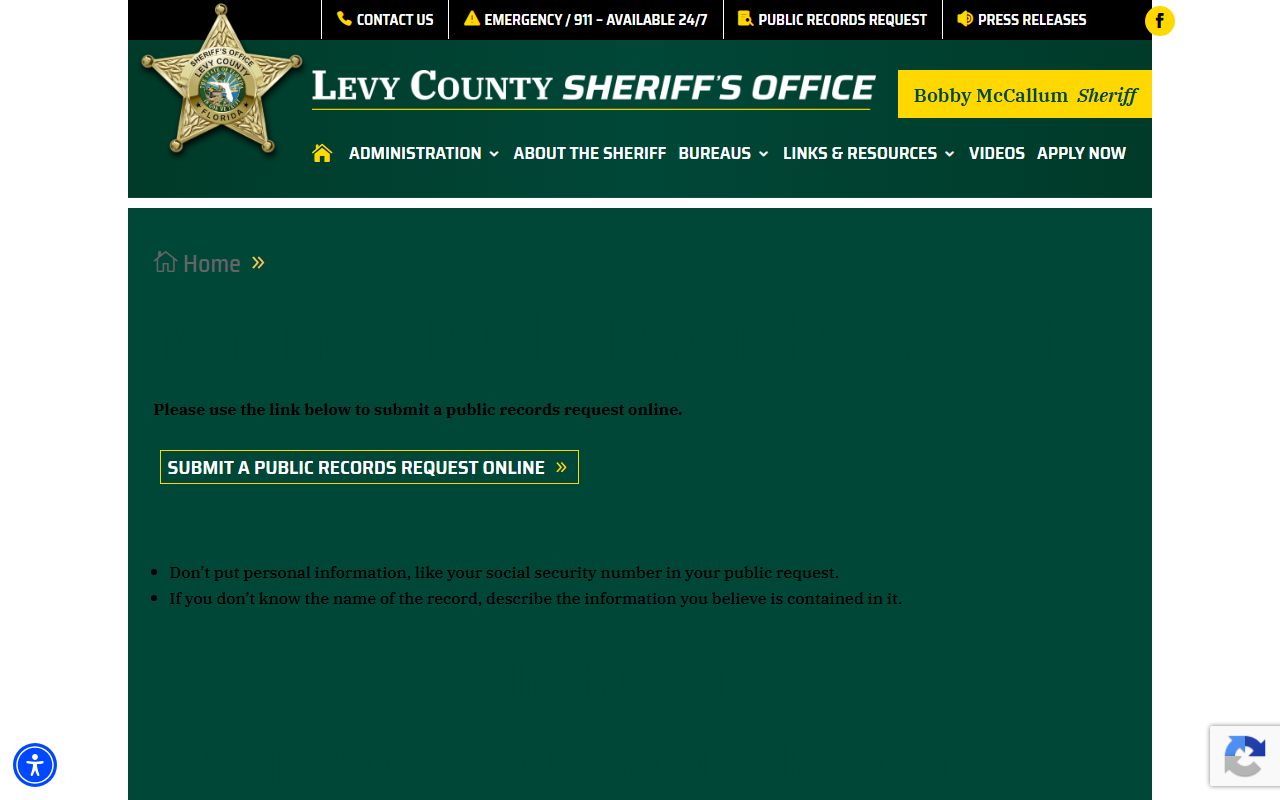
Submit the request through the sheriff's NextRequest portal and include the person's name, the approximate booking date, the words "arrest booking photograph," and the arrest or jacket number if you have it from the roster. The office advises against putting sensitive personal data, such as a Social Security number, in the request.
Levy County Mugshot Removal and Sealed Records
Removing a lawful public booking photo is not a simple website request. Florida's pay-to-remove law targets third-party publishers that demand money, not the sheriff's lawful publication of a public record. The real route to suppress a record runs through the courts. After a dismissal, acquittal, or other eligible outcome, a person may seek to seal or expunge the record, which then limits public access by law. This site does not name, link, or endorse any commercial mugshot or pay-to-remove service. To understand the records-clearing path, see sealing and expunging an arrest record.
Official Sources vs. Commercial Mugshot Sites
Stick to the official roster and the sheriff's records process. The Levy County JailTracker roster is the source the sheriff's office actually links, and a public records request is the lawful way to ask for a photo that is not posted. Those two channels are accurate, free or low-cost, and tied to the agency that holds the record.
Commercial mugshot websites are a different matter. They often copy booking photos in bulk, keep them online long after a case ends, and may charge to take them down. Florida law specifically regulates that pay-to-remove practice. Beyond the legal issues, those sites are frequently out of date and do not reflect a dismissal, an acquittal, or a sealed record. For an accurate picture of what happened with a charge, the court case record is the right source, not a third-party photo page.
Note: A booking photo shows an arrest, not a conviction, so always check the court disposition before drawing any conclusion from a mugshot.
Federal and State Booking Photos
Federal custody works differently. The Bureau of Prisons locator does not publish booking photos the way a county roster might; its results focus on a register number, age, race, sex, release date, and location. The ICE detainee locator is a search tool, not a photo gallery. Florida state prison records are separate again. Once a person is sentenced and transferred, the Florida Department of Corrections inmate population search can show a photo on the detail page, but that is the statewide system, not the Levy County jail roster.
This split matters when a photo is hard to find. If the person is not a current county inmate, no Levy booking photo will appear, even though a state or federal record may exist elsewhere. Match the search to the custody type first. Use the county roster for a current local inmate, the state locator for a sentenced prisoner, and the federal locators for federal or immigration custody, then request a specific booking photo from the agency that actually holds it.