
Levy County Court Records After a Jail Arrest
An arrest in Levy County begins with law enforcement and a booking at the jail. The court record comes next. The Office of the State Attorney for the Eighth Judicial Circuit reviews the case and decides what charges to file. When the prosecutor files, a case opens with the Levy County Clerk of the Circuit Court, and that filing becomes the court record. From then on, the case docket tracks the charges, hearings, bond orders, and the final result.
The booking side and the court side are not the same record. The booking and custody details, the roster, and the bond fields live on the jail side, covered in Levy County jail inmate records. The court record is the charges the prosecutor actually filed and what the court did with them. Booking charges can be amended, reduced, dropped, or replaced, so the court record is the authority on the case, not the arrest sheet.
How to Find Levy County Court Records After an Arrest
Levy County court records run through the Clerk's online case search, the OCRS portal. The portal offers a public anonymous option plus attorney, registered user, and party logins. All online access is governed under Florida AOSC 16-107, and the Clerk treats the online data as informational, not an official or certified record.
The Levy Clerk lists the access choices on the OCRS county access page.
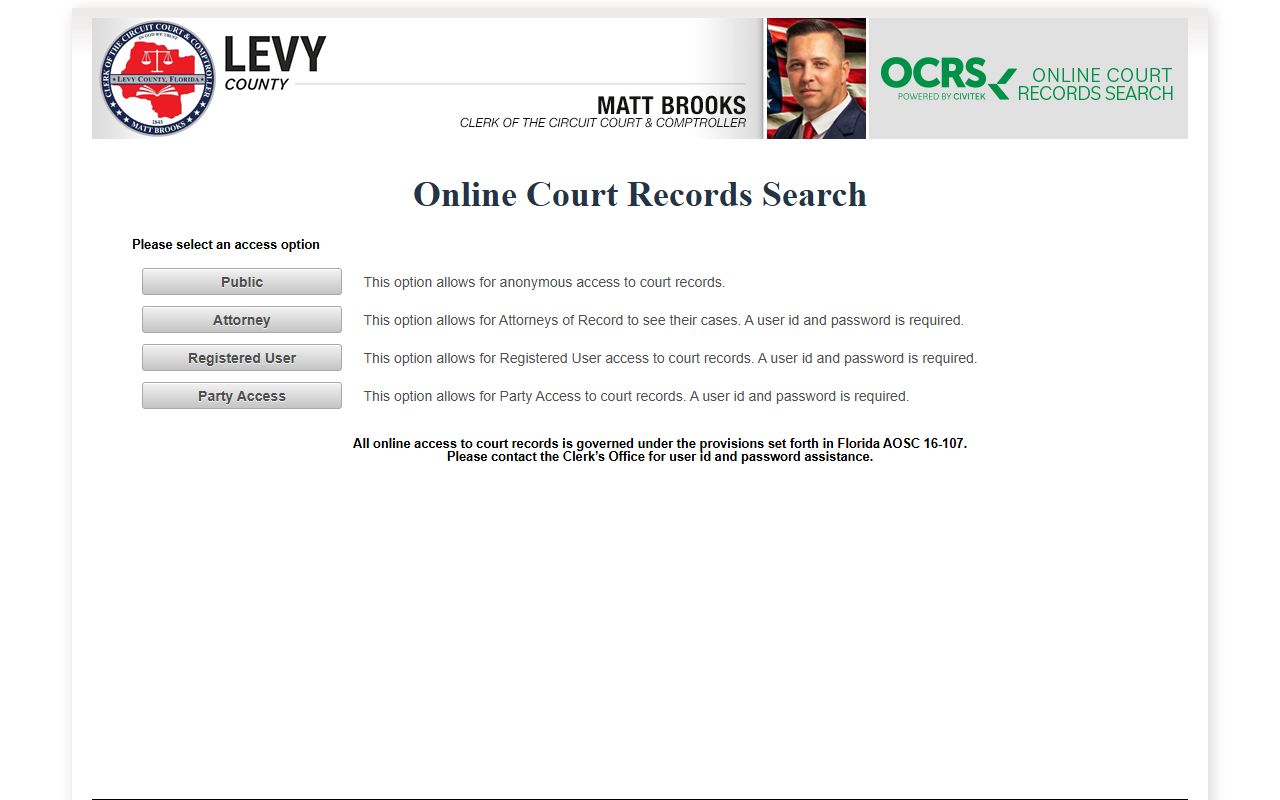
After choosing the public option, search by the identifiers the portal accepts, such as a party name or case number.
- Open the Levy County OCRS court case search and choose the public access option.
- Search by defendant name, or by case number if you saw one on the jail roster.
- Open the case and read the charge list and the docket entries.
- Check each charge's description, level, and current status, plus any bond order or hearing date.
For certified copies, contact the Clerk's office at the courthouse, since the online record is informational only. The Clerk is at 355 South Court Street, Bronson, open Monday through Friday, 8 AM to 5 PM.
How Charges Get Filed After an Arrest: Complaint, Information, and Indictment
The court record opens when the prosecutor files a charging document. Booking happens first at the jail, then the State Attorney decides what, if anything, to charge. In Florida, formal charges arrive by complaint, by information, or by indictment, depending on the case. State Attorney Brian Kramer leads the Eighth Judicial Circuit, which covers Alachua, Baker, Bradford, Gilchrist, Levy, and Union counties, and the office decides charges and prosecutes cases for Levy County.
The State Attorney's Levy County office is shown on the office's locations page.
The three main charging documents work as follows.
| Complaint | Information | Indictment | |
|---|---|---|---|
| Filed By | Officer or prosecutor | State Attorney | Grand jury |
| Common For | Misdemeanors and early charges | Many felonies | Capital and serious felonies |
| Starts | The case | The case | The case |
Levy County Charge Status After an Arrest
Charges change as a case moves. A prosecutor can amend, reduce, add, or drop counts, and a court can dismiss them. This is why a booking charge on the jail roster may not match the charge the State Attorney finally files. The terms below appear on Levy County court records after an arrest.
| Status | What It Means |
|---|---|
| Pending | The charge or case is still active and has not been resolved. |
| Amended / Reduced | The prosecutor or court changed the charge, often to a lesser count. |
| Dismissed | The court or prosecutor ended the charge. |
| Nolle Prosequi | The prosecutor declined to continue with the charge. |
| Withheld Adjudication | A Florida outcome where guilt may not be formally adjudicated despite a plea or finding. |
Note: A charge is an accusation, while adjudication or a plea is what settles guilt, so always read the disposition, not just the filed charge.
Bond and Release After a Levy County Arrest
Bond is set early. A person may be released before first appearance under a local bond schedule, or the judge reviews bond at the first appearance within 24 hours of arrest. The judge weighs probable cause and release conditions there. A hold or detainer can keep a person in custody even after a bond is otherwise handled, so the roster's hold fields matter as much as the bond amount.
| Bond Type | How It Works |
|---|---|
| Cash Bond | The full amount is paid to secure release and is returned when the case ends, less any fees. |
| Surety Bond | A licensed bail agent posts the bond for a non-refundable fee. |
| PR / Own Recognizance | Release on a written promise to appear, with no money required. |
| No-Bond Hold | Custody continues because a hold, detainer, or court order blocks ordinary release. |
The county roster can show bond type and amount, but it is not the payment authority. Call the Detention Bureau at 352-486-5121 before paying or hiring a bondsman to confirm the bond is payable and that no other hold blocks release.
Warrants Behind a Levy County Arrest
Many bookings begin with a warrant. A judge issues an arrest warrant on probable cause, or a court issues a bench warrant or capias when someone misses a hearing or violates a court order. Once an officer serves it, the Detention Bureau books the person, and the roster may show a warrant number, charge description, and bond or no-bond status. No public active-warrant search page or warrant phone line for Levy County was found in official sources reviewed. For bench warrants tied to a case, search the Levy County OCRS court records by name, or file a public records request with the sheriff's office for nonconfidential warrant records.
Charges vs. Convictions
Being arrested and charged is not the same as being convicted. A charge is an accusation that rests on probable cause. A conviction requires a plea or a verdict that proves guilt beyond a reasonable doubt. Both can be public records, but they sit at very different stages of a case.
| Charge | Conviction | |
|---|---|---|
| Stage | Accusation | Verdict or plea |
| Burden of Proof | Probable cause | Beyond a reasonable doubt |
| Public Record | Yes | Yes |
Sealed vs. Expunged Arrest Records
Florida lets some people clear an arrest record after an eligible outcome, such as a dismissal. Sealing hides a record from public view. Expunction goes further and has the record physically destroyed, with only narrow exceptions. Eligibility is set by statute and runs through the courts and the Florida Department of Law Enforcement, not a simple online request.
| Sealed | Expunged | |
|---|---|---|
| Visibility | Hidden from public view | Destroyed and treated as if it never existed |
| Law Enforcement | Limited access remains | Very limited access |
| Eligibility | Under Florida Statutes § 943.059 | Under Florida Statutes § 943.0585 |
Background Check Considerations
A casual court-record lookup is not a background check. Formal background screening for jobs, housing, or credit is regulated by the Fair Credit Reporting Act and must run through a compliant consumer reporting agency. Public court records are open to read, but using them to make those decisions falls under different rules.
Important: This site is not a consumer reporting agency under the FCRA, and nothing here may be used for employment, housing, credit, or insurance screening.
Jail, Court, and Prosecutor Records Are Not the Same
After an arrest, three separate record families exist, and they answer different questions. The jail booking record, held by the sheriff's office, shows current custody, the booking date, arrest charges, bond fields, and any holds. The court case record, held by the Clerk, shows the formal case number, the charges the prosecutor filed, the docket, court dates, and the final disposition. The prosecutor record, held by the State Attorney, covers the charging decision and related filings where they are public.
Knowing which one you need prevents a common mistake. A charge on the jail roster is an arrest charge and can change. The Clerk's case record is where the filed charges and outcome live, though the online version is informational and not certified. The State Attorney decides what to prosecute, and the court controls the disposition. For the custody and booking side of this split, see how booking photos and roster records work.
Restricted Court Records After an Arrest in Levy County
Not every record after an arrest is open. Juvenile cases, sealed or expunged charges, and certain victim or witness details are restricted under Florida law. Active investigations can also be withheld for a time. The Clerk's online data carries a disclaimer that it is informational and may change without notice, and the State Attorney's office notes that exemptions, work product, and victim information can limit what is released. The State Attorney guarantees access under Florida's public records law but may charge for the cost of compiling a request, with Brian Kramer listed as the public records custodian.